
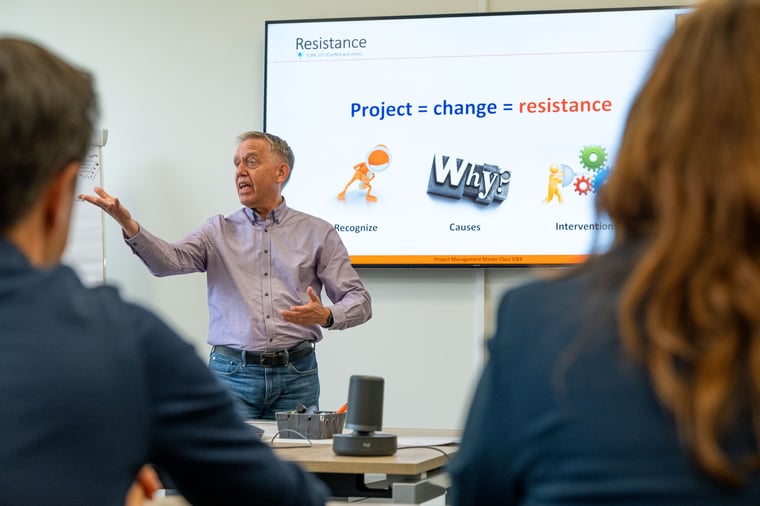
Complex projects rarely follow the original plan. Objectives evolve. Stakeholder interests compete. Dependencies grow. Technical challenges emerge, and decisions must often be made before all the information is available.
Successful project management therefore requires more than methods, schedules and reporting. It requires the ability to create direction, influence the project environment and keep people moving towards a shared result.
That is the central focus of our Project Management Masterclass: an intensive four-day training program that helps professionals turn project management knowledge into decisive, practical action.
Project management is about creating movement
A project manager is not simply responsible for maintaining a plan. A strong project manager actively shapes the conditions in which the team can succeed.
That means taking initiative instead of waiting for problems to escalate. It means understanding stakeholder interests, challenging assumptions and addressing uncertainty early. It also means adapting your leadership style to the situation, the team and the phase of the project.
During the masterclass, participants learn how to become an influencing project manager: someone who combines structure with personal leadership and turns complexity into focused action.
The goal is not to control every change. It is to respond effectively to change—and, when necessary, initiate the changes that move the project forward.
Combining structure, agility and leadership
There is no single project management method that fits every project.
Traditional planning provides structure and clarity. Agile approaches support learning and adaptation. Systems engineering helps manage technical complexity. Leadership and behavioural skills determine whether stakeholders and teams actually support the chosen direction.
The Project Management Masterclass connects these perspectives.
Participants explore the product creation process, the V-model and Agile ways of working. They learn how to prepare a project, manage stakeholders, structure work, estimate effort and translate an objective into an executable plan. They also examine communication, teamwork, motivation, situational leadership and change management.
Rather than treating these subjects as separate disciplines, the training shows how they reinforce one another in real projects.
What will you learn?
The program is divided into two blocks covering four connected themes.
Day 1: The mindset of the influencing project manager
The first day focuses on taking initiative and creating direction. Participants examine the power of action and the mindset required to influence a project environment.
The program also introduces the V-model, Agile working and the product creation process, followed by project preparation and stakeholder management.
Day 2: Leadership and behavioural competences
Projects are delivered by people. The second day therefore concentrates on project organisation, communication, teamwork and leadership.
Participants explore how behaviour affects project results and how situational leadership, motivation and involvement can strengthen team performance.
Day 3: Making a plan as a thinker and a doer
A useful project plan must do more than describe activities. It must connect the intended result, technical structure, people, resources, risks and decision-making process.
Participants work through the ten steps of the planning process, including Scrum principles. They practise project decomposition, structuring and estimating, and connect tools such as the product breakdown structure and Design for X to practical project planning.
Day 4: Project execution and control
The final day brings the elements together in project execution.
Participants learn how to create a clear project rhythm—or “heartbeat”—and use planning tools in a way that supports the team rather than creating additional administration. The day also covers practical implementation, monitoring, communication and change management.
Learning through practical experience
The masterclass is designed to bridge the gap between theory and everyday project reality.
The trainers are experienced project and program managers who have led multidisciplinary product-development initiatives in high-tech, medtech and industrial environments. They bring practical examples, proven approaches and lessons from complex projects into the classroom.
Participants are encouraged to connect the methods directly to their own working environment. This makes the program relevant not only during the four training days, but also when returning to active projects and teams.
Who is the masterclass for?
The Project Management Masterclass is designed for professionals who want to strengthen their project management, leadership and stakeholder-management capabilities.
This includes:
- Project and program managers
- System engineers and lead engineers
- Buyers and supply-chain professionals
- Product-development professionals
- Technical and functional leaders
- Professionals preparing for broader project responsibility
A technical background is not required. The program is suitable for anyone who works in a project-driven environment and wants to become more effective in creating alignment, managing uncertainty and achieving results.
Preparing for IPMA C
After completing the full training, participants receive proof of participation.
Combined with the accompanying self-study, the masterclass also prepares participants for the IPMA C theory examination. Additional guidance is available for professionals continuing towards the full IPMA C assessment, including support with experience documentation, the management summary, self-assessment and interview preparation.
Move beyond managing the plan
Strong project managers do not wait for ideal circumstances. They create clarity when information is incomplete. They bring people together when interests differ. They combine thinking with action and maintain momentum when the project changes.
The Project Management Masterclass helps professionals develop exactly these capabilities.
You will leave with practical methods, a stronger leadership mindset and a clearer understanding of how to influence your team, stakeholders and project environment.
Because successful project management is not only about following a plan.
It is about creating the movement that turns ambition into results.


.jpg?width=200&name=Holland%20Innovative%20summer%20academy%20-%20Project%20Management%20Masterclass%202%20(2).jpg)


